Skip to content

    Regulation (EU) 2024/2847 · reporting since 11 Sep 2026

    Cyber Resilience Act compliance software

    Risk assessment, technical documentation (Annex VII) and the EU declaration, then vulnerability handling and the 24-hour reporting of Article 14. AI drafts from your documents; you review, sign and stay responsible.

    We reply within 24 hours to schedule a call, then a personalised demo and a proposal with pricing.

    Reporting obligations
    Since 11 September 2026
    Full application
    11 December 2027
    Your files
    Encrypted, hosted in the EEAAI functions run through US providers
    Self-assessment
    Module A for default-category products

    Article 14: the clock starts when you become aware

    UTC clocks

    You become aware of an actively exploited vulnerability or a severe incident

    1. 24 h

      Early warning

      Without undue delay, and within 24 hours of becoming aware.

    2. 72 h

      Notification

      Within 72 hours, with the details known so far.

    3. 14 daysor 1 month

      Final report

      14 days after a corrective or mitigating measure is available for a vulnerability, one month after the notification for an incident.

    RedComply runs each case on UTC clocks, reminds you by email and drafts every notification. You submit them to the coordinator CSIRT and ENISA on the EU single reporting platform.

    Article 14Also applies to products already on the marketThe three Article 14 deadlines RedComply runs for every reporting case.

    Trusted by manufacturers for their EN 18031 files

    • Modulonda s.r.l.
    • Glowmesh Technologies Ltd
    • Startec s.r.l.
    • Metrivolt s.r.l.
    • Sarvento Automazione s.r.l.
    • CampoSense s.r.l.
    • Caldermere Systems Ltd
    • Coldspan Ltd
    • Greyport Telemetry Ltd

    01Scope

    Does the CRA apply to your product?

    Most likely, if it connects to a device or a network and is supplied in the course of a commercial activity, paid or free.

    Is your product in scope?

    • A product with digital elements made available on the EU market: connected hardware, its firmware, or software placed on the market on its own
    • Its intended or reasonably foreseeable use includes a direct or indirect data connection to a device or a network

    The exclusions are narrow

    • Products under the medical device and in vitro diagnostic regulations
    • Vehicle type-approval
    • Certified aviation products
    • Marine equipment
    • Identical spare parts
    • Products developed only for national security or defence, or to process classified information

    Both lines fit and no exclusion? Then the CRA most likely applies.

    Internet-connected radio product? RED Cybersecurity applies too, mandatory since 1 August 2025. See what EN 18031 requires

    Most products fall in the default category and can be self-assessed under Module A. Important products (Classes I and II) and critical products follow stricter routes.

    For now, Class I important products need a Notified Body.

    Tell us what you make: we get back to you within 24 hours.

    What RedComply is, and what it is not

    Free · 25 questions

    Not sure how ready you are?

    Our free CRA readiness assessment: 25 questions on the ENISA maturity model for SMEs, with a score and guidance for your level.

    Start the assessment

    02See it working

    The CRA workflow on the real dashboard. From your documents to the declaration.

    See it done

    The RedComply dashboard on a CRA project; waiting times are shortened. No sound; pause it at any time.

    03What you get

    One place for the work before market placement and the duties that follow it.

    Before you place the product on the market

    Risk · documentation · declaration

    Risk assessment

    Cybersecurity risk assessment, step by step

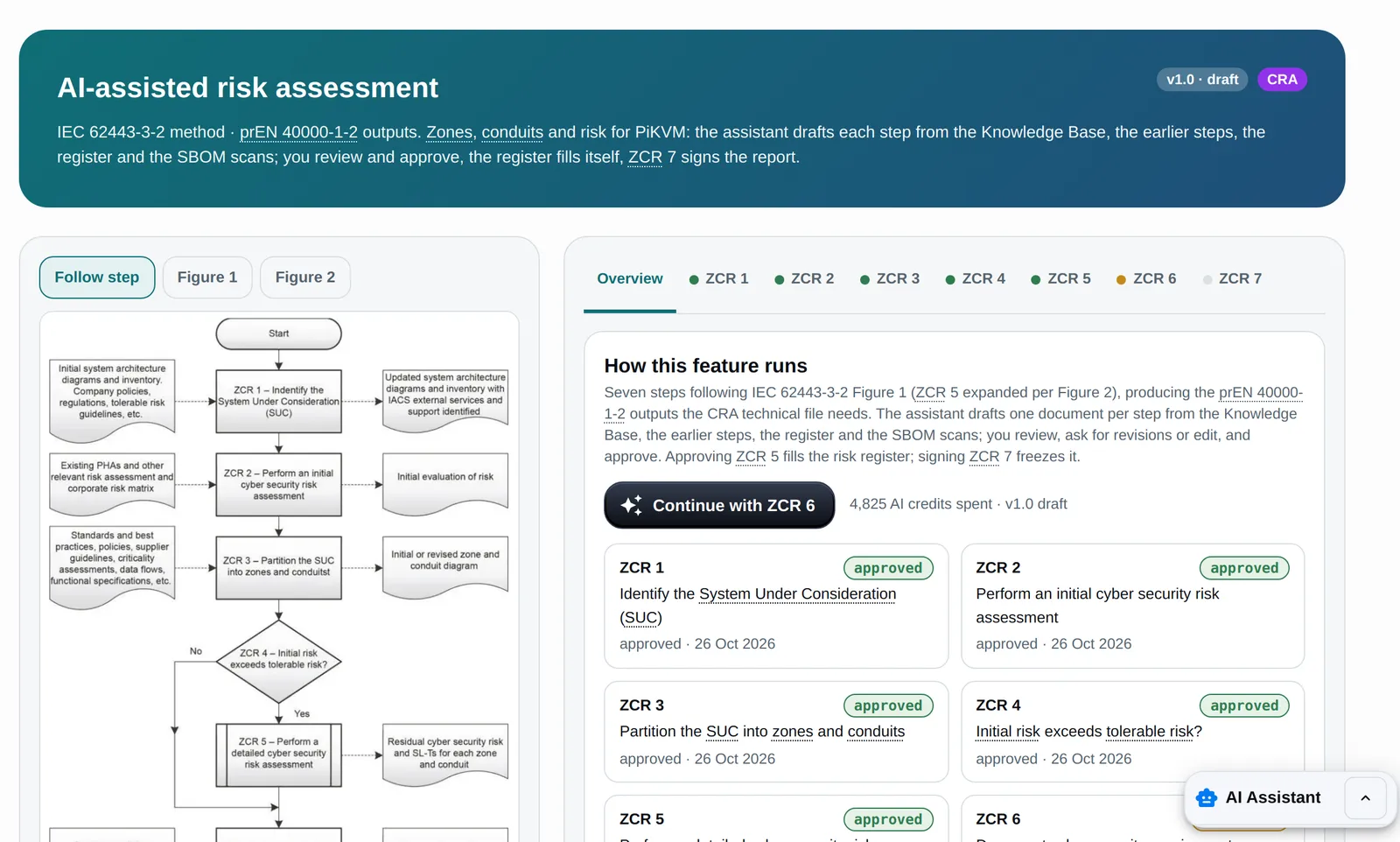
    The risk assessment follows the IEC 62443-3-2 workflow in seven steps, from defining the system under consideration to the signed report. An AI agent drafts each step from your Knowledge Base, the earlier steps and your SBOM scans; you comment, edit and approve before the next step opens, then sign the report.

    • One step at a time, each one approved by you
    • Revisions driven by your comments
    • Signed report filed in the Knowledge Base
    RedComply AI-assisted risk assessment following IEC 62443-3-2, with steps ZCR 1 to ZCR 7 and their approval status

    Risk assessment · IEC 62443-3-2

    1. ZCR 1: Approved
    2. ZCR 2: Approved
    3. ZCR 3: Approved
    4. ZCR 4: Approved
    5. ZCR 5: Approved
    6. ZCR 6: To review
    7. ZCR 7: Locked
    View the full screenshot: risk assessment (opens the full-size screenshot in a new tab)

    Risk register

    Risk register with treatment tasks

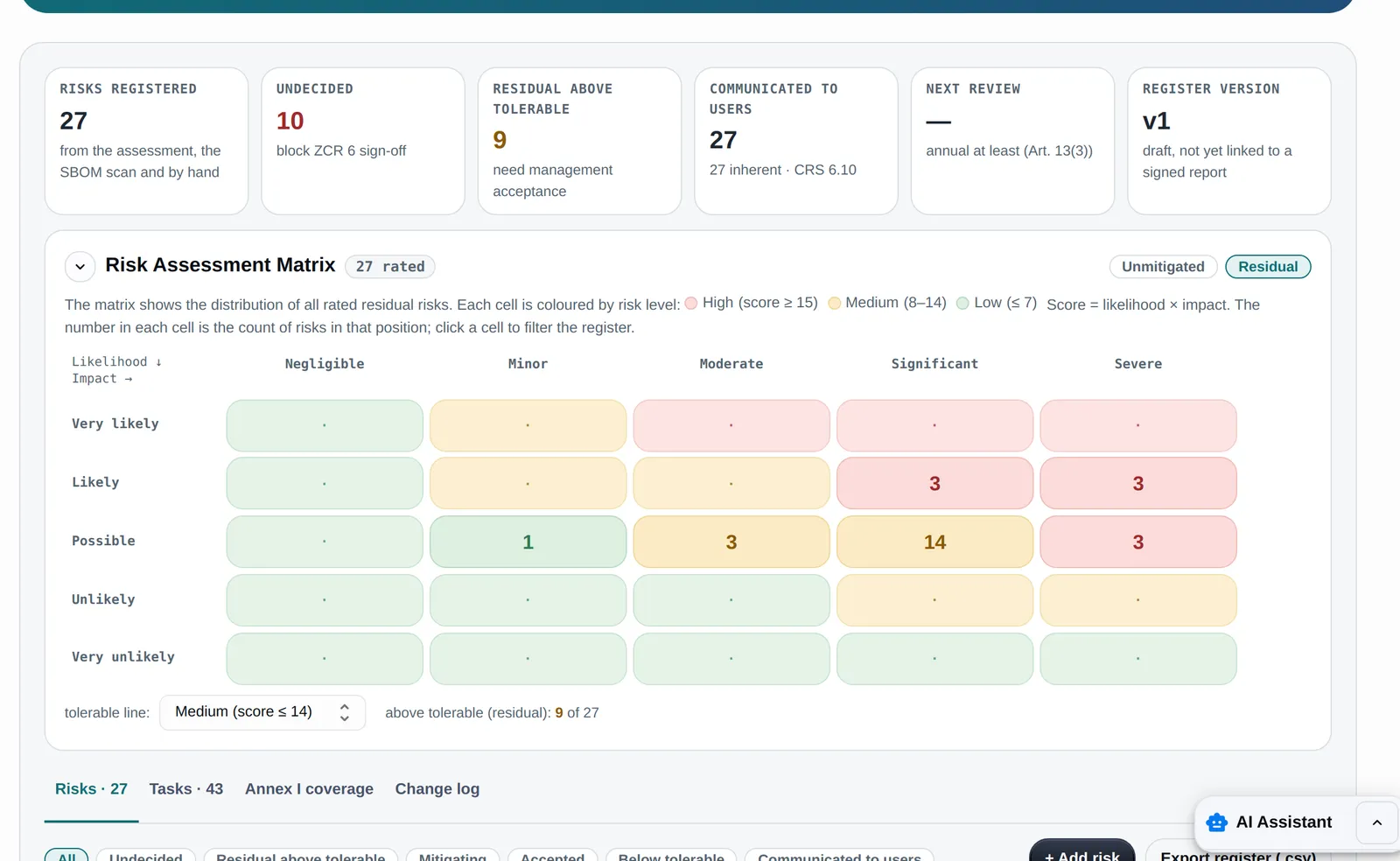
    Approved risks land in a register with likelihood, impact and residual scores on a 5 × 5 matrix, a treatment decision for each risk, and countermeasure tasks with an owner and a due date.

    • Avoid, mitigate, accept or transfer, with the reason
    • Tasks tracked until done
    • Change log and frozen versions
    RedComply risk register with the 5 by 5 risk matrix of residual risks

    Risk register · 5 × 5 matrix

    Likelihood × impactUnmitigated and residual scores

    View the full screenshot: risk register (opens the full-size screenshot in a new tab)

    Annex VII

    Technical documentation (Annex VII)

    The CRA’s essential requirements are mapped onto the EN 18031 tables you may already have, and CRA-specific requirements cover the rest. The documentation is bundled the way Annex VII lists it. EN 18031 covers part of Annex I, but gives no presumption of conformity under the CRA.

    • EN 18031 tables reused, not rewritten
    • CRA-specific requirements from RedComply's provisional catalogue
    • Annex VII bundle ready to download
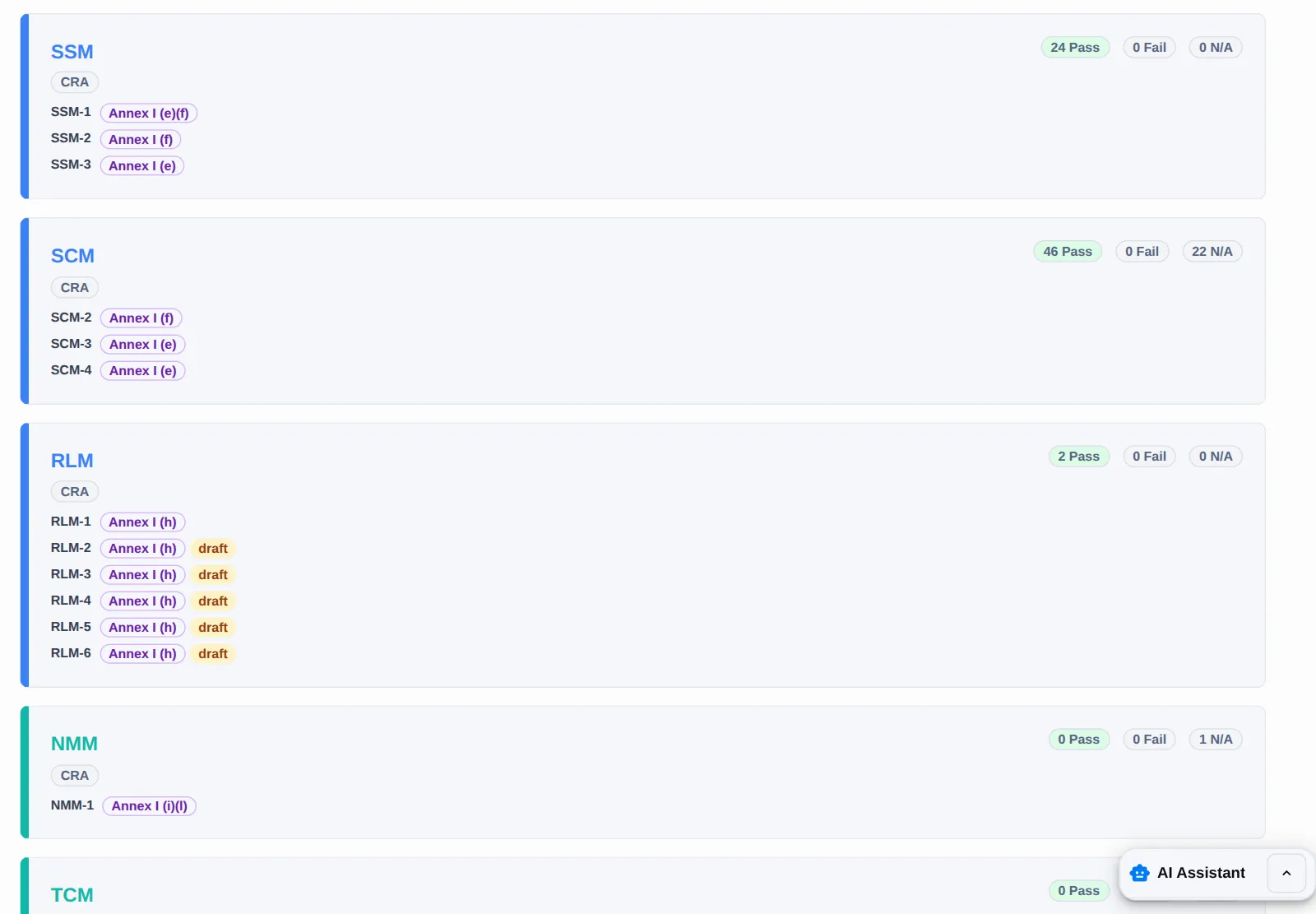
    RedComply device report in the Cyber Resilience Act view, with the Annex I letter of each requirement and the CRA-specific requirements marked as drafts

    Device report · CRA view

    EN 18031 tables, reused
    SSM-1SCM-2RLM-1
    CRA-specific, marked draft
    RLM-2RLM-3draft
    View the full screenshot: device report, CRA view (opens the full-size screenshot in a new tab)

    Annex V and VI

    EU declaration of conformity, CE marking and labels

    Issue the Annex V declaration in the languages you sell in, publish it on its own public page and print the simplified declaration of Annex VI. The CE marking checklist, the product label and the Annex II user information are drafted from the facts you entered.

    • Versions, languages and a public publication page
    • Simplified declaration and label sheet
    • Annex II information and instructions for users
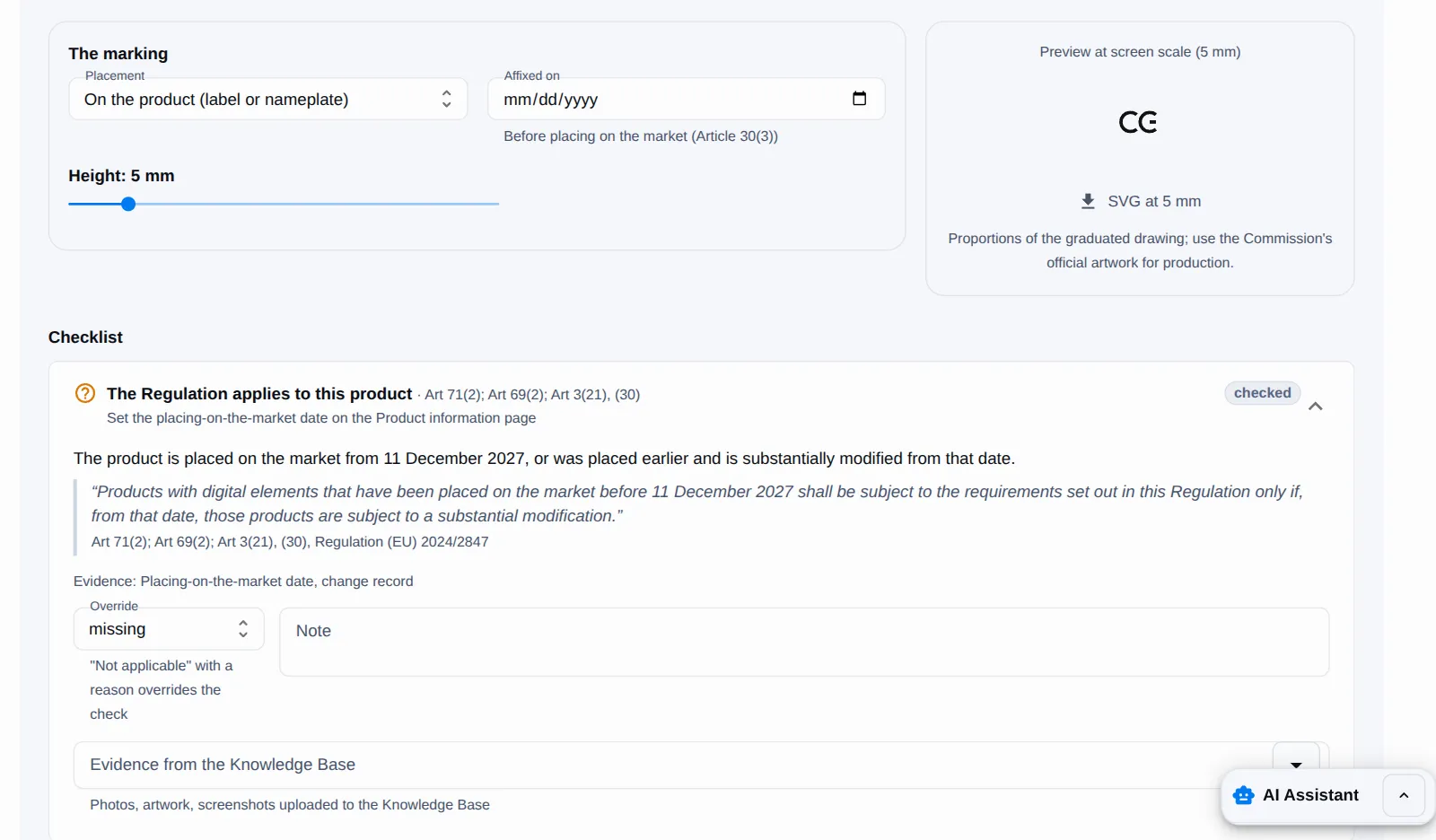
    RedComply CE marking tab with the placement and height of the marking, its preview and the first item of the CE marking checklist

    CE marking · checklist

    Placement
    On the product (label or nameplate)
    Height
    5 mm, with its SVG

    Each item quotes the Regulation and names its evidence.

    View the full screenshot: CE marking checklist (opens the full-size screenshot in a new tab)

    “RED cybersecurity compliance under EN 18031 felt overwhelming: three standards, endless tables, and no clear starting point. RedComply used AI to extract our security information and automatically fill the compliance tables, so instead of staring at blank templates, I was reviewing drafts. I completed the documentation in about 40 hours, and work I expected to take months was review-ready in two weeks.”

    Niccolò CrosaraTech Lead, Startec s.r.l.About EN 18031 work, which RedComply reuses for the CRA

    During the support period

    Vulnerabilities · reporting · conduct

    SBOM scans

    Nightly SBOM vulnerability scans

    Every night the SBOM of each part of your product is scanned against vulnerability databases and checked against the EU and CISA lists of actively exploited vulnerabilities. You get an email when new or changed findings appear.

    • One SBOM per part: operating system, application, firmware
    • Actively exploited vulnerabilities flagged
    • What changed since the last scan
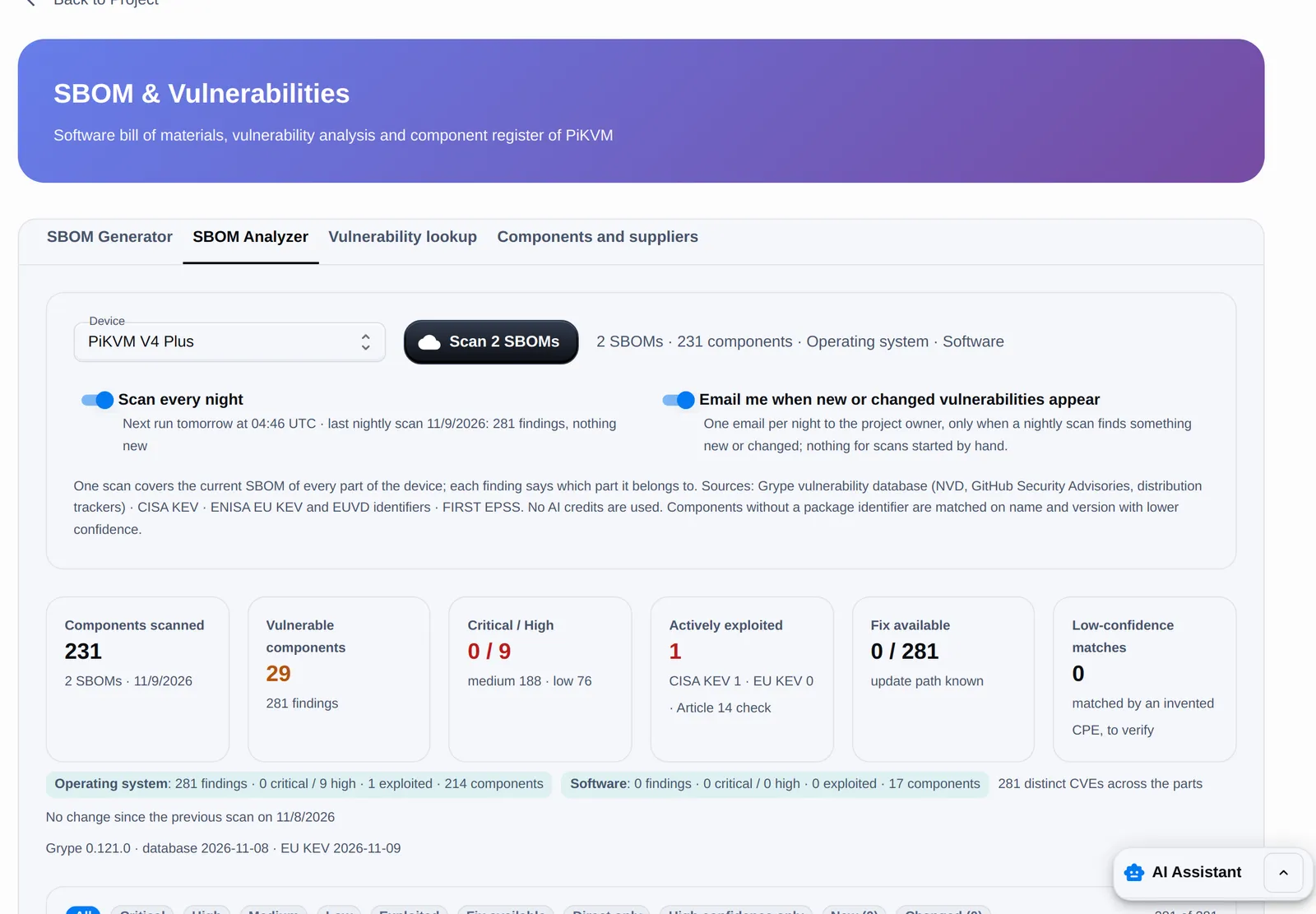
    RedComply SBOM analyzer with nightly scans, vulnerable components and actively exploited findings

    SBOM analyzer · per device

    2 SBOMs scanned, one per part
    Operating system · Software
    Actively exploited
    CISA KEV 1 · EU KEV 0
    Since the previous scan
    No change
    View the full screenshot: SBOM analyzer (opens the full-size screenshot in a new tab)

    Article 14

    Article 14 reporting workflow

    Open a case from an exploited finding or by hand. RedComply starts the clocks, proposes your coordinator CSIRT from your main establishment, drafts the early warning, the notification and the final report with every element Article 14 asks for, and keeps the submission record.

    • UTC clocks with email reminders
    • Drafts ready for the single reporting platform
    • Notice to users under Article 14(8)
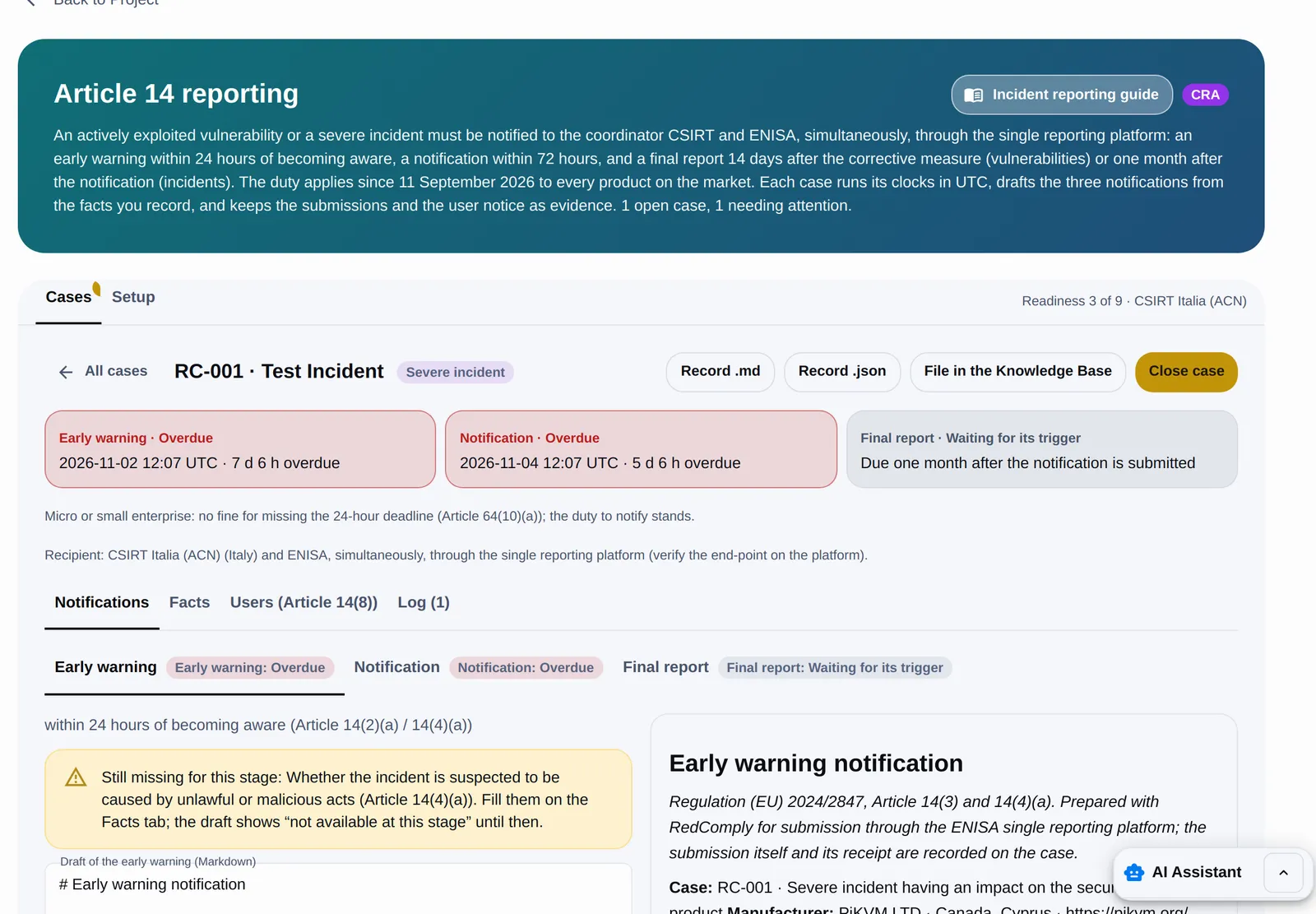
    RedComply Article 14 reporting case with the early warning, notification and final report clocks and the drafted early warning

    Article 14 case · the record

    Coordinator CSIRT
    Proposed from your main establishment
    Early warning, notification, final report
    Drafted for you to submit
    Notice to users
    Article 14(8)
    Submission
    Reference recorded
    View the full screenshot: Article 14 reporting case (opens the full-size screenshot in a new tab)

    Disclosure

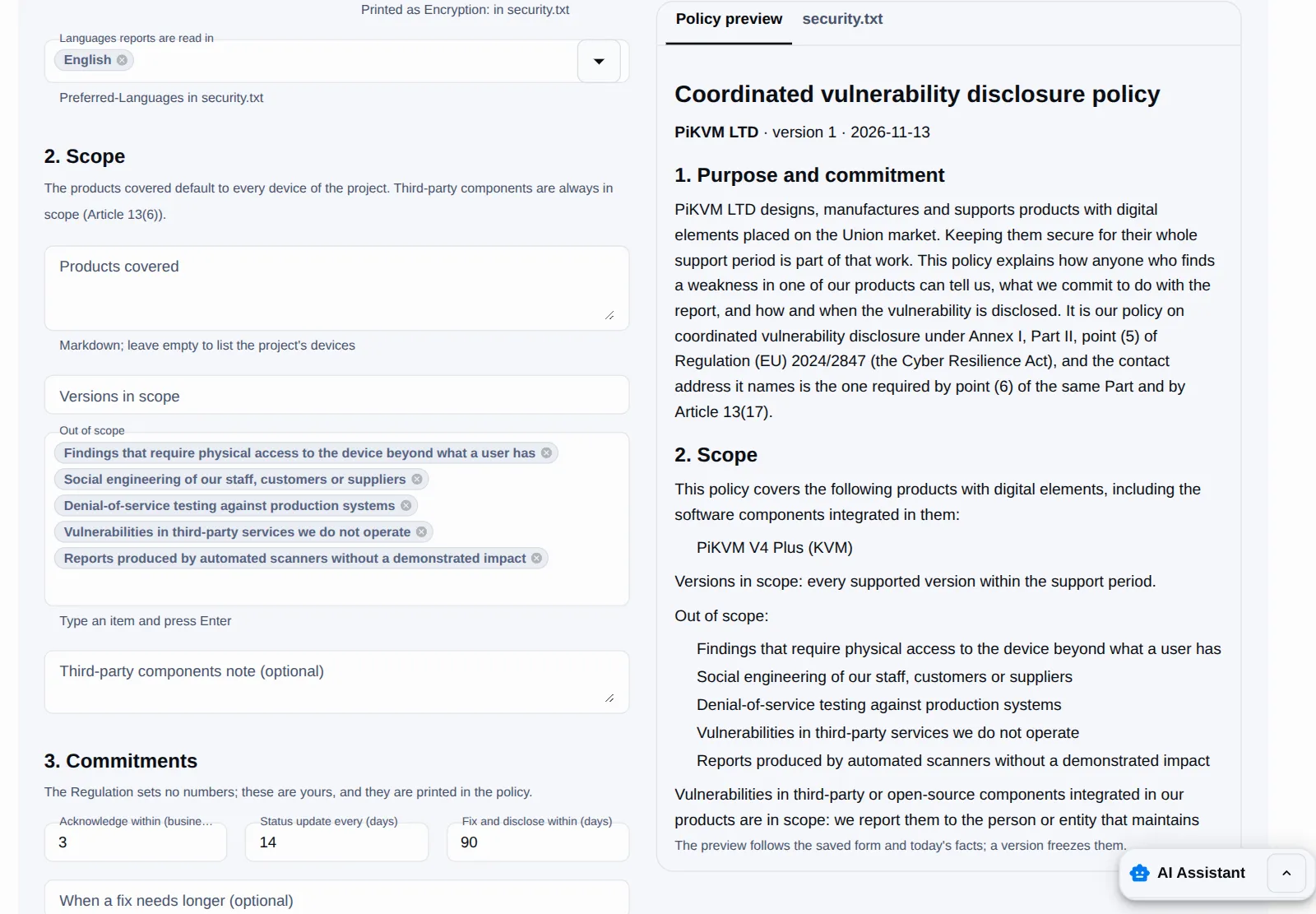
    Coordinated vulnerability disclosure policy

    Write your disclosure policy in a guided form and publish it with a security.txt file, so researchers know how to reach you. The published address is linked from your product information.

    • Second, non-automated reporting channel
    • Versions issued as Markdown, PDF and security.txt
    • Public page on redcomply.com or your own site
    RedComply coordinated vulnerability disclosure policy form with its scope and commitments, beside the live preview of the policy

    Disclosure policy · security.txt

    Contact: mailto:security@…Expires: 2027-11-20T00:00:00ZPolicy: https://redcomply.com/security/…
    View the full screenshot: disclosure policy form (opens the full-size screenshot in a new tab)

    Support period

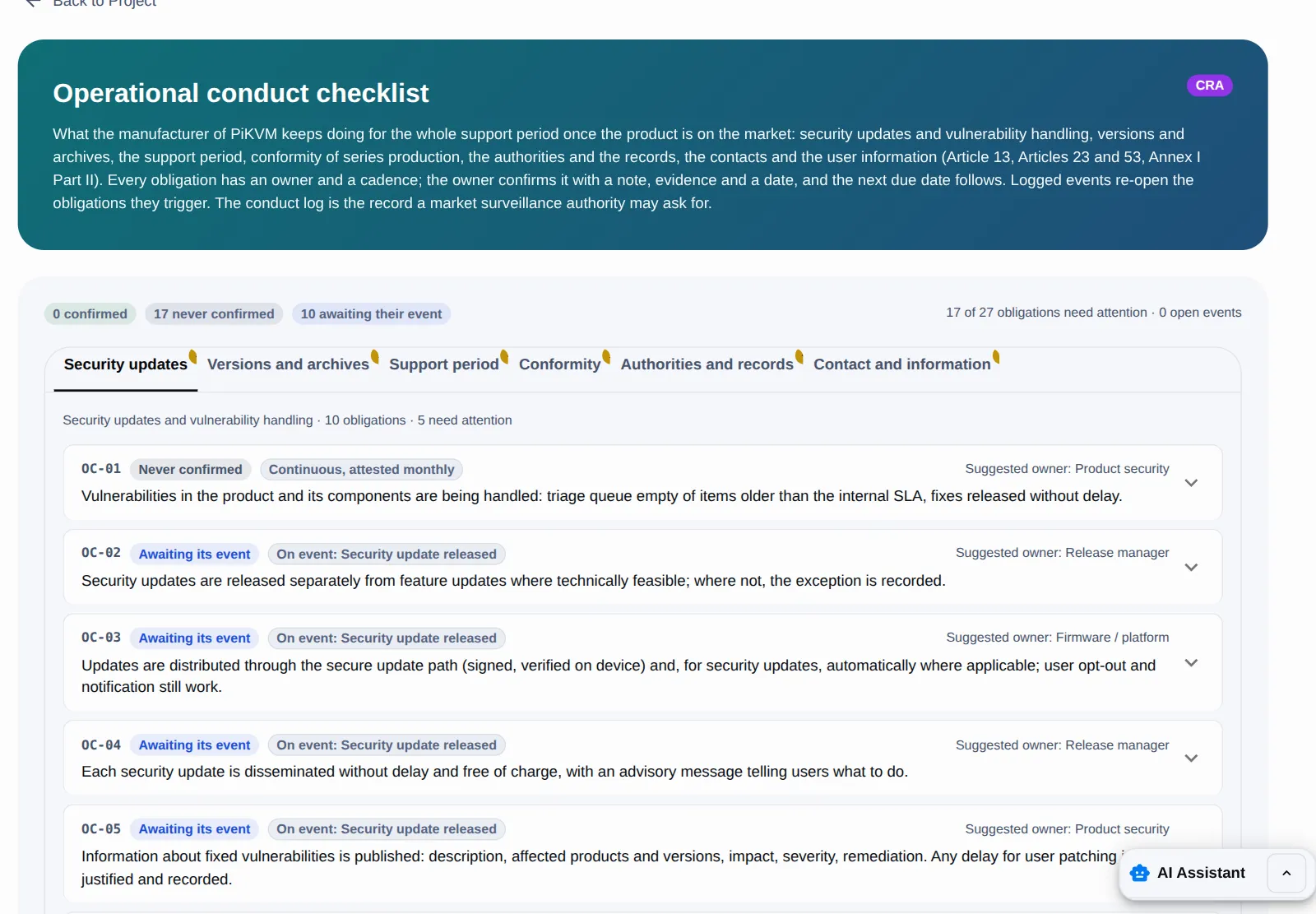
    Operational conduct checklist

    Track the 27 obligations you keep up for the whole support period, from security updates to keeping the documentation, as RedComply groups them from the Regulation. Each has an owner, a cadence and the date it was last confirmed.

    • Due and overdue obligations at a glance
    • Events that re-open the obligations they affect
    • Conduct log exported for the technical file
    RedComply operational conduct checklist with the obligations of the security updates theme, their state, cadence and suggested owner

    Conduct · security updates

    • OC-01Never confirmedContinuous, attested monthly
    • OC-02Awaiting its eventOn event: Security update released
    View the full screenshot: operational conduct checklist (opens the full-size screenshot in a new tab)

    04What manufacturers say

    Manufacturers on RedComply, in their own words

    Their words are about EN 18031 work, which RedComply reuses in the CRA technical documentation.

    • “Our controllers sit in buildings for fifteen years, which makes update and vulnerability handling the hard clauses. RedComply broke EN 18031 into questions our engineers could actually answer, and the DoC generator produced something I was comfortable signing.”

      Richard BownessTechnical Director, Caldermere Systems Ltd

    • “We ship temperature loggers across the EU and the RED deadline was genuinely keeping me up at night. Six weeks from first login to a signed Declaration of Conformity, with an evidence trail I can show a market surveillance authority without panicking. Our board even asked how we managed it so quickly.”

      Michael OsborneOperations Director, Coldspan Ltd

    Get StartedPricing depends on your products and your needs: after a personalised demo you get a proposal with pricing.

    MCP · In pilot

    Draft the CRA technical documentation from your source code

    Connect the coding agent your developers already use, such as Claude Code, Codex or Cursor, through RedComply's Model Context Protocol (MCP) server. It answers RedComply's questions from the repository on your machine, with file references; RedComply drafts the technical documentation tables of the CRA requirements and you review them. The risk assessment and the risk register are planned on the same connection.

    See how it works with your coding agent

    How your coding agent and RedComply work together

    05Before you decide

    What RedComply is, and what it is not

    1. Self-assessment under Module A

      Most products are in the default category and can be self-assessed under Module A; that is what RedComply supports. Class I important products can be self-assessed only when the manufacturer applies in full a harmonised standard, a common specification or a European cybersecurity certification scheme. None of these can be used for the CRA yet, so for now they need a Notified Body. Class II and critical products always need a third-party assessment.

    2. A provisional catalogue, marked as draft

      No harmonised standard for the CRA has been cited in the Official Journal yet (November 2026). Until then, CRA-specific requirements follow RedComply's provisional catalogue, drafted from the draft standard prEN 40000-1-4 and marked as drafts.

    3. You remain the manufacturer responsible

      RedComply drafts and organises; you review, sign and remain the manufacturer responsible. It is not a Notified Body and does not certify products.

    4. You submit the reports

      RedComply does not submit reports for you: it drafts them for you to submit on the single reporting platform.

    EN 18031 · Directive 2014/53/EU

    Already working on EN 18031?

    Build your EN 18031 file now and carry it into the CRA: RedComply reuses your EN 18031 tables in the CRA technical documentation.

    Since 1 Aug 2025
    RED cybersecurity applies to internet-connected radio equipment, and to radio toys, childcare and wearable equipment that process personal data.
    From 11 Dec 2027
    Products placed on the market before this date stay under RED cybersecurity, and the CRA is expected to take over after it.

    See what EN 18031 requires

    06Free to use

    Free CRA resources

    07FAQ

    Frequently asked questions

    Get Started
    Does the CRA apply to my product?

    Most likely, if it connects to a device or a network: connected hardware, its firmware and software placed on the market on its own, paid or free, when supplied in the course of a commercial activity. The exclusions are narrow and listed in the scope section of this page.

    How long does it take?

    Drafting a file with RedComply typically takes about two to three weeks, instead of six to twelve months by hand. Testing time comes on top and depends on your product. You see progress from the first day and can export preliminary reports within days.

    Is my data safe?

    Your files stay in your project and are encrypted in transit and at rest. The platform is hosted in the European Economic Area; AI functions run through providers in the United States. We are working towards ISO 27001 certification.

    What does it mean that RedComply is AI-powered? Isn't it just templates?

    Templates are the starting point. The AI assistant reads your uploaded technical documents (datasheets, architecture diagrams, security policies) and drafts the answers into your EN 18031 tables, with the source for each one. It works through the decision trees, points out where your documentation and your evidence disagree, and updates verdicts when an input changes. You review and approve every answer.

    Can I self-assess under the CRA?

    Yes for products in the default category, which is most products: you follow Module A (internal control), draw up the technical documentation and sign the declaration. Class I important products can be self-assessed only when you apply in full a harmonised standard, a common specification or a European cybersecurity certification scheme at assurance level 'substantial' or higher. None of these can be used for the CRA yet, so for now they need a Notified Body (Modules B + C or H). Class II and critical products always need a third-party assessment.

    No harmonised CRA standard has been cited yet. What does RedComply follow?

    The essential requirements of Annex I apply directly. To make them concrete, RedComply uses the EN 18031 tables that map onto them and a provisional catalogue of CRA-specific requirements drafted from the draft standard prEN 40000-1-4. Those requirements are marked as drafts and will be updated once harmonised standards are cited in the Official Journal.

    Does the CRA replace RED cybersecurity?

    Yes, in practice, for products placed on the market from 11 December 2027. The CRA's requirements include everything RED cybersecurity asks, and the Commission is expected to switch off the RED cybersecurity rules for these products (by repealing or amending Delegated Regulation (EU) 2022/30) (CRA recital 30). Products placed on the market before that date stay under RED cybersecurity unless they are substantially modified later. Your EN 18031 tables carry into the CRA file, although EN 18031 alone does not prove CRA conformity.

    How do updates work when I release a new firmware?

    RedComply shows which requirements a change affects. You update those parts, re-check the verdicts and, when the change calls for it, issue a new version of the declaration. Every version is kept, and the nightly SBOM scans keep checking the software components of each release.

    Today · · 386 days until the CRA applies in full

    Get your product ready for the CRA

    Start with one product family: risk assessment, documentation and reporting set-up in one place.

    Request a demo and a pricing quote for your products.